💍 How To Not Invite Family To Wedding

Wedding Planning
No fluff, no drama. Just easy weekly advice, planning shortcuts, and gentle reminders to help you actually enjoy your engagement.
Planning your wedding should be a season of joy, but for many, it feels like a high-stakes negotiation with family members you would rather not see.
I have spent years advising couples on how to protect their peace during major life events, drawing from my own experience of setting firm boundaries with difficult relatives.
This guide provides a tactical roadmap to help you navigate these sensitive conversations while keeping your sanity and your vision for the big day intact.
Quick Overview
Deciding who does not make the cut is often harder than choosing who does, requiring a mix of emotional intelligence and logistical planning.
- Time needed: 2 to 4 weeks of planning and communication
- Difficulty: Intermediate to Advanced (depending on family dynamics)
- What you’ll need: A unified front with your partner, a clear guest list policy, and prepared scripts for difficult conversations
Step-by-Step Instructions
Step 1: Define Your Shared Vision
Sit down with your partner before you even look at a guest list to discuss what you want the day to feel like.
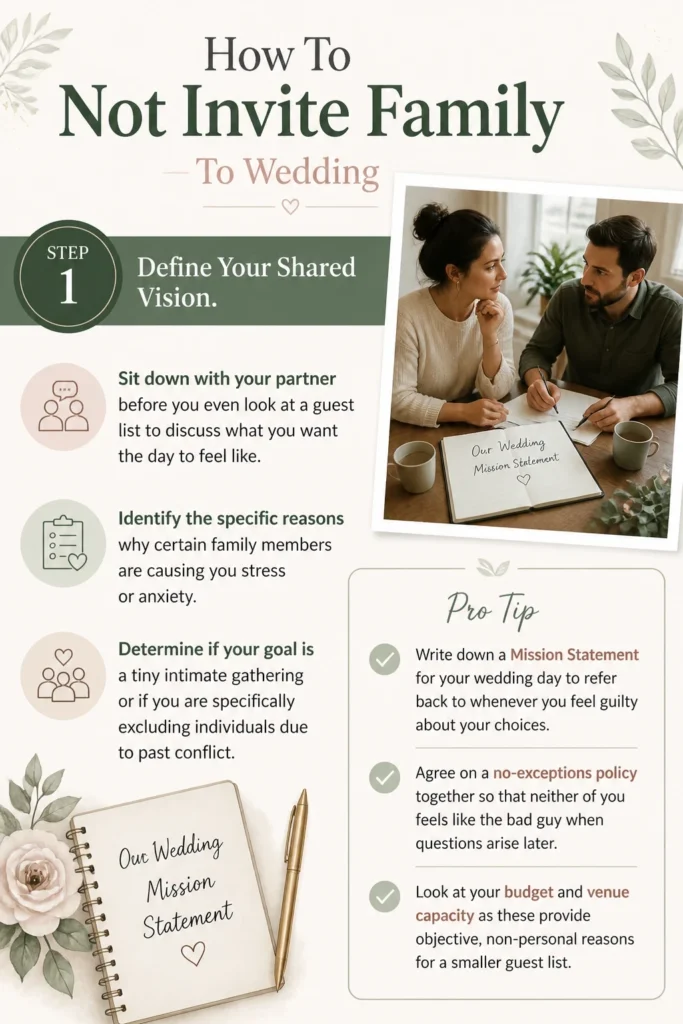
Identify the specific reasons why certain family members are causing you stress or anxiety.
Determine if your goal is a tiny intimate gathering or if you are specifically excluding individuals due to past conflict.
Pro Tip: Write down a “Mission Statement” for your wedding day to refer back to whenever you feel guilty about your choices.
Agree on a “no-exceptions” policy together so that neither of you feels like the “bad guy” when questions arise later.
Look at your budget and venue capacity as these provide objective, non-personal reasons for a smaller guest list.
Step 2: Establish Objective Cut-Off Rules
Create a set of “rules” that apply to everyone equally to avoid the appearance of playing favorites or targeting specific people.
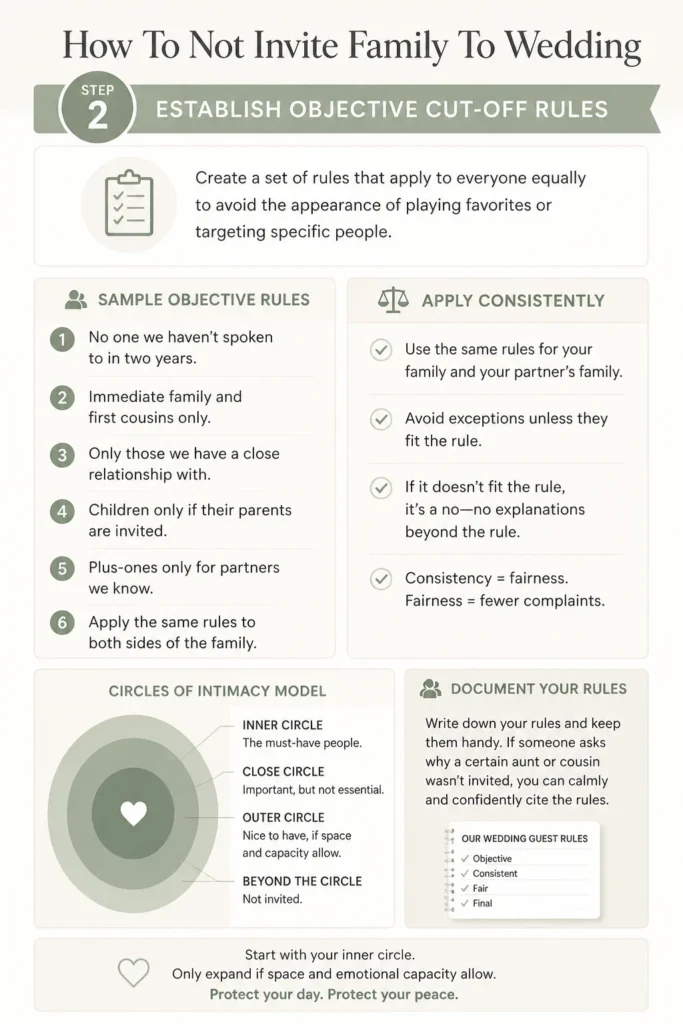
Consider rules like “no one we haven’t spoken to in two years” or “immediate family and first cousins only.”
Apply these rules consistently across both sides of the family to ensure fairness and reduce the grounds for complaints.
Document these rules so you can cite them easily if a relative asks why a certain aunt or cousin wasn’t invited.
Focus on the “circles of intimacy” model, where you start with your inner circle and only expand if space and emotional capacity allow.
Step 3: Draft Your Official Responses
Prepare short, kind, but firm scripts for when people inevitably ask about their invitation status.
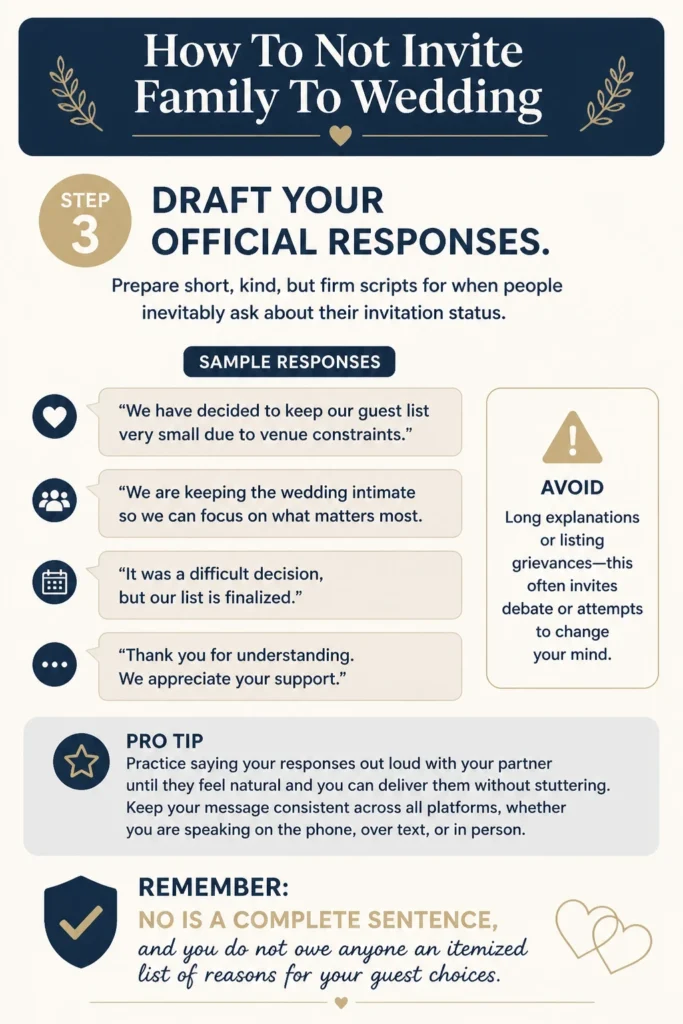
Use phrases like, “We have decided to keep our guest list very small due to venue constraints,” to keep the focus on logistics.
Avoid long explanations or listing grievances, as this often invites the other person to argue or try to “fix” the problem.
Pro Tip: Practice saying your responses out loud with your partner until they feel natural and you can deliver them without stuttering.
Keep your message consistent across all platforms, whether you are speaking on the phone, over text, or in person.
Remember that “No” is a complete sentence, and you do not owe anyone an itemized list of reasons for your guest choices.
Step 4: Communicate Early and Directly
Reach out to the people who might expect an invitation but won’t be receiving one before the formal invites go out.
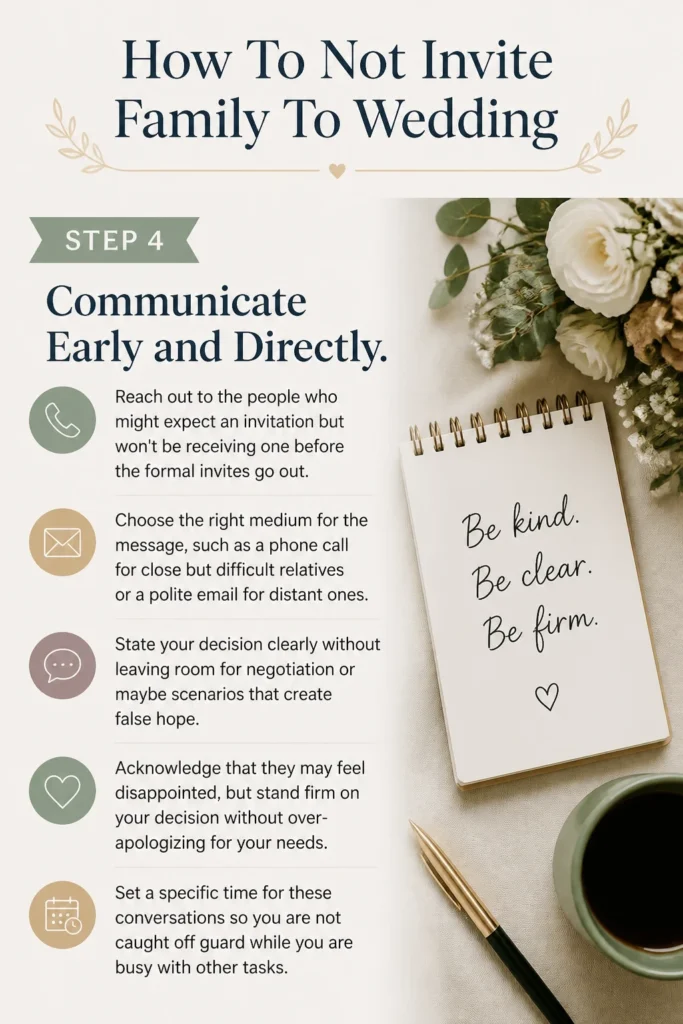
Choose the right medium for the message, such as a phone call for close but difficult relatives or a polite email for distant ones.
State your decision clearly without leaving room for negotiation or “maybe” scenarios that create false hope.
Acknowledge that they may feel disappointed, but stand firm on your decision without over-apologizing for your needs.
Set a specific time for these conversations so you are not caught off guard while you are busy with other tasks.
Step 5: Secure Your Digital Presence
Password-protect your wedding website to prevent uninvited guests from seeing the schedule, location, or registry details.
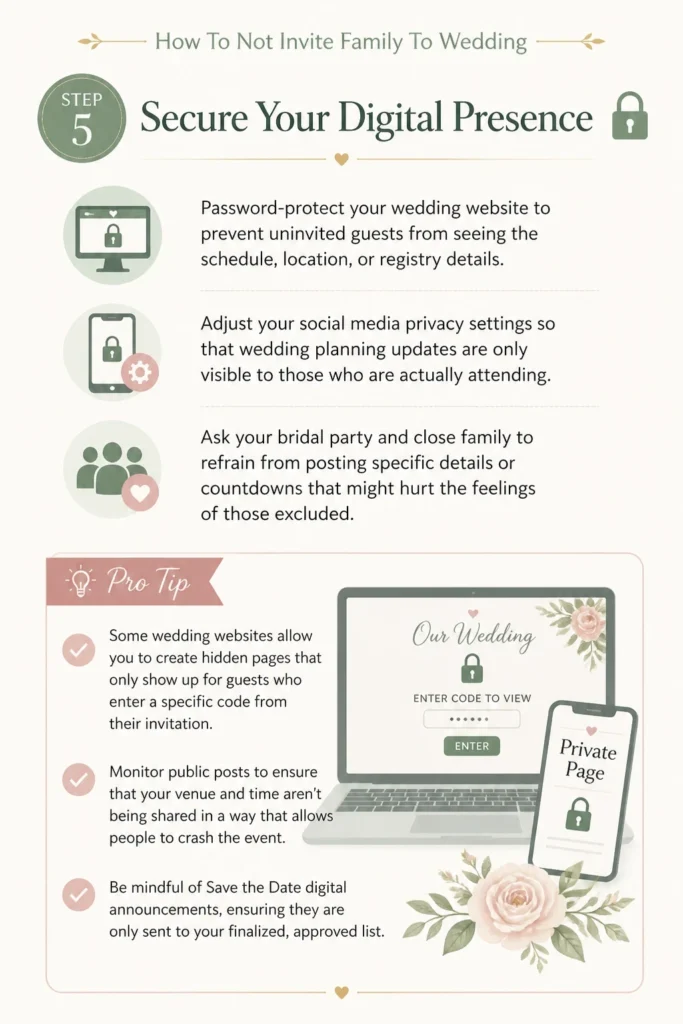
Adjust your social media privacy settings so that wedding planning updates are only visible to those who are actually attending.
Ask your bridal party and close family to refrain from posting specific details or countdowns that might hurt the feelings of those excluded.
Pro Tip: Some wedding websites allow you to create “hidden” pages that only show up for guests who enter a specific code from their invitation.
Monitor public posts to ensure that your venue and time aren’t being shared in a way that allows people to “crash” the event.
Be mindful of “Save the Date” digital announcements, ensuring they are only sent to your finalized, approved list.
Step 6: Handle Financial Influences
Evaluate any financial contributions from family members very carefully before accepting them.
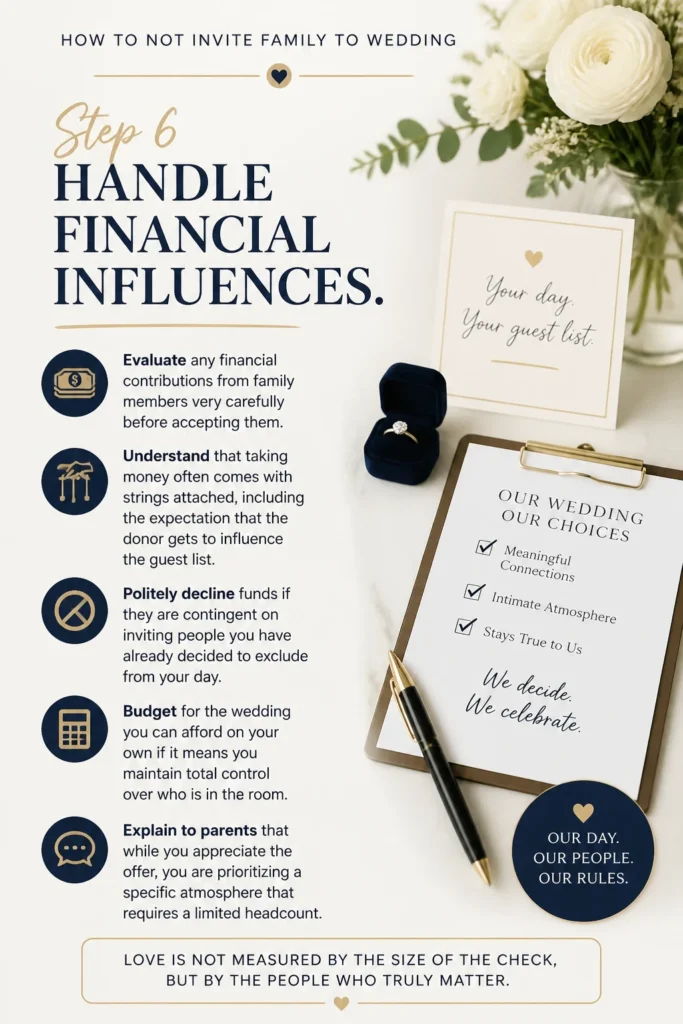
Understand that taking money often comes with “strings attached,” including the expectation that the donor gets to influence the guest list.
Politely decline funds if they are contingent on inviting people you have already decided to exclude from your day.
Budget for the wedding you can afford on your own if it means you maintain total control over who is in the room.
Explain to parents that while you appreciate the offer, you are prioritizing a specific atmosphere that requires a limited headcount.
Step 7: Assign a Gatekeeper
Designate a trusted friend, bridesmaid, or wedding coordinator to handle any “gate-crashers” or awkward questions on the day of.
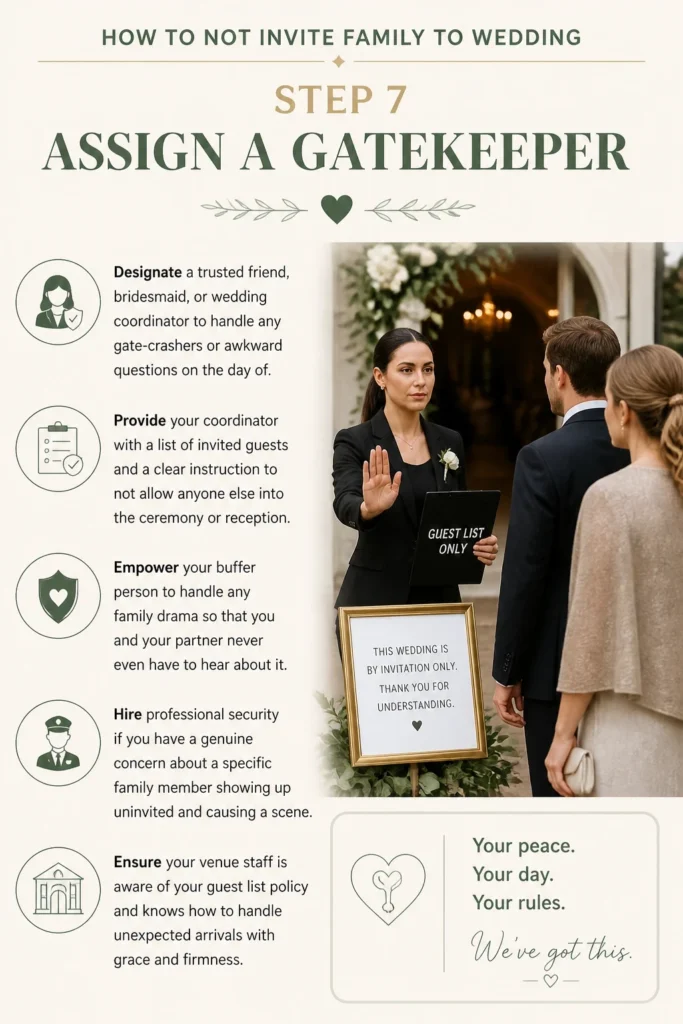
Provide your coordinator with a list of invited guests and a clear instruction to not allow anyone else into the ceremony or reception.
Empower your “buffer person” to handle any family drama so that you and your partner never even have to hear about it.
Hire professional security if you have a genuine concern about a specific family member showing up uninvited and causing a scene.
Ensure your venue staff is aware of your guest list policy and knows how to handle unexpected arrivals with grace and firmness.
Step 8: Prepare for the Emotional Fallout
Recognize that some family members may react with anger, guilt trips, or “the silent treatment” following your decision.
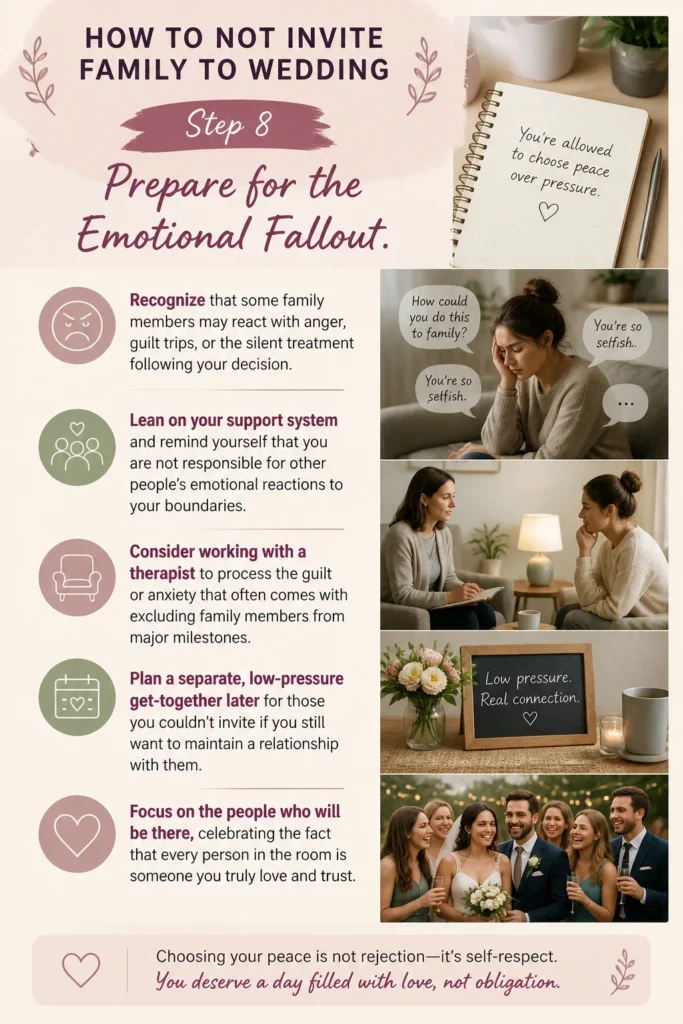
Lean on your support system and remind yourself that you are not responsible for other people’s emotional reactions to your boundaries.
Consider working with a therapist to process the guilt or anxiety that often comes with excluding family members from major milestones.
Plan a separate, low-pressure get-together later for those you couldn’t invite if you still want to maintain a relationship with them.
Focus on the people who will be there, celebrating the fact that every person in the room is someone you truly love and trust.
Common Mistakes to Avoid
The “Maybe” Trap
One of the biggest errors couples make is giving vague answers like “We’re still working on the list” or “We’ll see if we have space.” This creates a sense of hope for the uninvited person and makes it much harder to say no later. It is far better to be clear from the start than to lead someone on for months only to disappoint them at the last minute.
Over-Explaining and Justifying
When you provide a long list of reasons for why someone isn’t invited, you are essentially giving them a list of points to argue against. If you say you don’t have enough money, they might offer to pay for their own plate. If you say the venue is small, they might suggest you change venues. Stick to a simple, firm statement that the decision is final and based on your overall vision for the day.
The Social Media Leak
Posting photos of your invitations, dress shopping, or venue tours can trigger intense feelings of exclusion for those who aren’t on the list. While you should be able to share your joy, doing so in a way that feels like “rubbing it in” can escalate family tensions. Keep the public posts to a minimum or use “Close Friends” lists on social platforms to share updates with the people who are actually attending.
Inconsistent Rule Application
If you tell your aunt she can’t come because you aren’t inviting any extended family, but then you invite your partner’s favorite cousin, you are creating a recipe for disaster. People talk to each other, and inconsistencies will be discovered. Make sure your rules are applied across the board so that no one feels singled out or unfairly excluded.
Troubleshooting
The Guilt-Tripping Parent
If a parent is pressuring you to invite people you don’t want, you must have a direct conversation about your boundaries. Explain that while you value their input, this day is about your partnership and your comfort. If they are paying for the wedding, you may need to offer to return their money to maintain your guest list autonomy. Be prepared for them to be upset, but remain calm and consistent in your messaging.
The “Flying Monkey” Relative
Sometimes, an uninvited person will send another family member to lobby on their behalf. When this happens, do not engage in the debate with the messenger. Simply say, “I’ve already spoken with [Name] about this, and the decision is final. I’d rather talk about something else with you.” This prevents the drama from spreading and shows that your boundaries cannot be bypassed by third parties.
The Accidental Save-the-Date
If you accidentally sent a “Save the Date” to someone you no longer wish to invite, you have a difficult but necessary task ahead of you. You must reach out as soon as possible and explain that there has been a change in plans or venue capacity. It is an awkward conversation, but it is much better than having them show up on the day of the wedding or waiting for an invitation that never arrives.
Key Takeaways
- Establish a unified front with your partner before communicating with any family members.
- Use objective rules to determine the guest list to minimize the feeling of personal attacks.
- Keep your explanations short, firm, and focused on logistics rather than personal grievances.
- Protect your wedding details with passwords and privacy settings to avoid uninvited guests.
- Assign a buffer person or professional security to handle any potential issues on the day of the event.
- Accept that you cannot control other people’s reactions and focus on your own peace of mind.
Frequently Asked Questions
Is it rude to not invite family to my wedding?
It is not inherently rude to curate your guest list based on your budget, venue capacity, or personal relationships. A wedding is a private celebration of your commitment, not a public event or a mandatory family reunion. You have the right to surround yourself with people who support and love you, regardless of biological ties.
How do I tell someone they aren’t invited without hurting them?
While you cannot control how someone else feels, you can be kind and direct. Focus the conversation on the limitations of the event rather than the flaws of the person. Using phrases like “We are keeping things very small” or “We’ve had to make some really tough choices” helps soften the blow while still maintaining the boundary.
What if my parents are paying and insist on inviting their friends or family?
This is a common “power struggle” in wedding planning. If you want total control, the best path is to pay for the wedding yourselves. If you accept their money, you may need to compromise by giving them a specific number of “invites” they can use, or you must be prepared to decline the money if their guest list demands compromise your mental health.
Should I invite someone just to keep the peace?
Inviting someone out of obligation often leads to resentment and stress on your actual wedding day. Ask yourself if you will be able to relax and enjoy your moment if that person is in the room. If their presence will make you anxious or uncomfortable, it is better to deal with the temporary drama of not inviting them than the permanent memory of them ruining your day.
Our Top Recommended Finds
- Boundary-Setting Books: “Set Boundaries, Find Peace” by Nedra Glover Tawwab is an excellent resource for learning how to say no to family without guilt.
- Password-Protected Wedding Websites: Platforms like Riley & Grey or specialized WordPress themes allow you to lock your site so only invited guests can see the details.
- High-Quality “Just Married” Cards: Sending a beautiful announcement card after the wedding is a classier way to let uninvited family know the event has passed without making them feel forgotten during the planning phase.
Taking Control Of Your Celebration
Setting boundaries with family is a skill that will serve you long after the wedding cake has been eaten.
By handling your guest list with clarity and firmess today, you are setting the tone for how your new family unit will interact with others in the future.
If you found this guide helpful, you might also want to look into our resources on managing wedding day anxiety or how to plan a “micro-wedding” on a budget.
Start by sitting down with your partner tonight to finalize those “non-negotiable” guest list rules and take the first step toward a stress-free wedding day.
Wedding Planning
No fluff, no drama. Just easy weekly advice, planning shortcuts, and gentle reminders to help you actually enjoy your engagement.