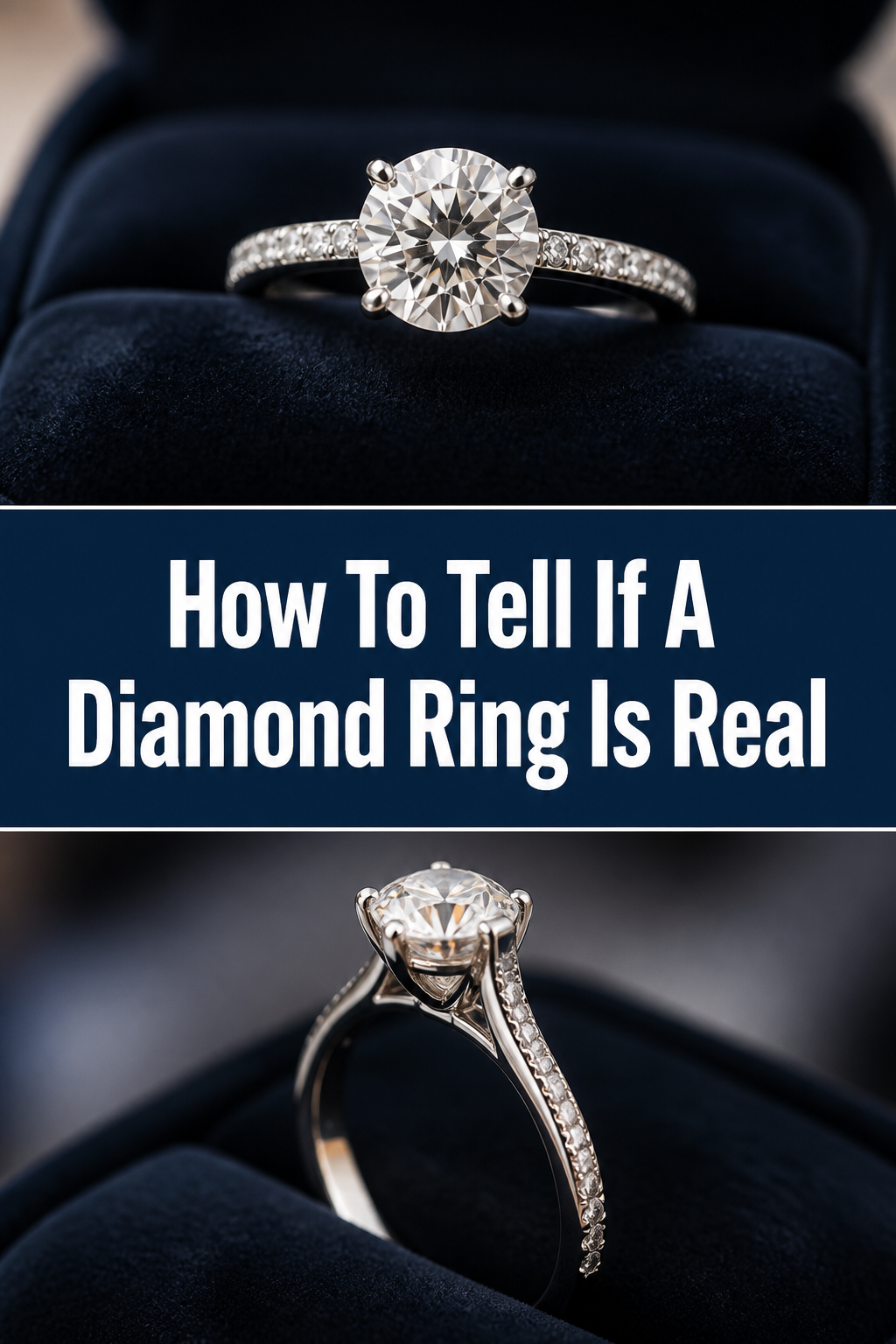
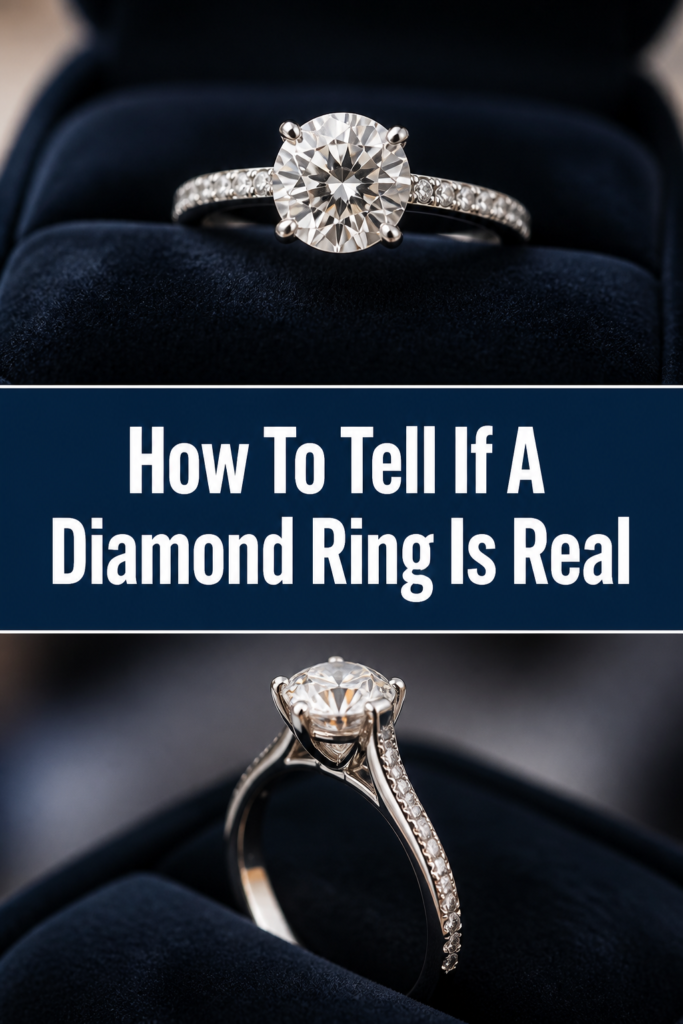
💎 How To Tell If A Diamond Ring Is Real

Wedding Planning
No fluff, no drama. Just easy weekly advice, planning shortcuts, and gentle reminders to help you actually enjoy your engagement.
Finding a diamond ring in a dusty drawer or at an antique shop is a thrilling moment.
I have spent years working with precious stones and have seen many people lose money on clever glass imitations.
This guide provides you with the same professional techniques I use to verify a diamond’s authenticity at home.
Quick Overview
You will learn how to distinguish a genuine diamond from common simulants like cubic zirconia or moissanite. These tests range from simple visual inspections to physical challenges that test the stone’s unique properties.
- Time needed: 20-30 minutes
- Difficulty: Beginner
- What you’ll need: A glass of water, a jeweler’s loupe or magnifying glass, a lighter, a piece of sandpaper, and a flashlight.
Step-by-Step Instructions
Step 1: Perform the Fog Test
Hold the diamond ring between two fingers and breathe a puff of air onto the stone. You want to create a light layer of condensation on the surface, just like you would on a window or a mirror.
Watch how quickly the fog disappears from the surface of the gemstone. A real diamond is an incredible conductor of heat and will disperse the moisture almost instantly.
If the stone remains fogged for two or three seconds, it is likely a fake. Materials like glass or cubic zirconia do not conduct heat efficiently and will hold onto the moisture much longer.
Pro Tip: Ensure the stone is clean before trying this, as oils from your skin can sometimes affect how moisture reacts with the surface.
Step 2: Try the Water Drop Test
Find a glass of normal room-temperature water and fill it about three-quarters of the way. Carefully drop the loose stone or the ring into the water and watch its behavior as it falls.
A real diamond has a very high density and will sink straight to the bottom of the glass immediately. It will not float or hover in the middle of the water column.
Many fakes, including some types of glass or quartz, are less dense and may sink more slowly. While this test is not foolproof for all simulants, it is a great way to rule out cheap glass imitations.
Step 3: Conduct the Dot Test
This test measures the refractivity of the stone, which is how it bends light. Find a plain white piece of paper and draw a small dot with a black pen or marker.
Place the stone onto the dot with the flat side down. Look through the pointed end of the diamond down onto the paper.
If the stone is a real diamond, you should not be able to see the dot or a circular reflection of it. Diamonds bend light so sharply that you cannot see straight through them.
If you can see the dot clearly or even a distorted circular shape, the stone is likely a fake. Materials like cubic zirconia have lower refractive indices and allow light to pass through more directly.
Pro Tip: This test works best on loose stones, as the metal setting of a ring can block your line of sight.
Step 4: Examine the Setting and Hallmarks
Take a close look at the metal band that holds the stone. Real diamonds are expensive, so they are almost always set in high-quality precious metals.
Look inside the band for stamps like 10K, 14K, 18K, 585, 750, 925, or PT. These indicate the purity of the gold, silver, or platinum used in the ring.
If you see a stamp that says “CZ,” the stone is cubic zirconia, which is a synthetic simulant. If the metal is plated or shows green oxidation, the stone is very unlikely to be a real diamond.
Jewelers do not put a high-value diamond in a cheap, gold-plated lead or brass setting. The quality of the craftsmanship in the metal often reflects the quality of the stone.
Step 5: Use a Jeweler’s Loupe
A loupe is a small magnifying glass used by professionals to see fine details. You can find these online for a very low price, and they are essential for serious inspection.
Look for “inclusions,” which are tiny natural imperfections found in almost every mined diamond. These might look like small black spots, tiny cracks, or white flecks known as clouds.
If the stone looks absolutely perfect and flawless under 10x magnification, be suspicious. While flawless diamonds exist, they are incredibly rare and extremely expensive.
Check the edges of the facets where the flat surfaces meet. A real diamond will have sharp, crisp edges, while a fake made of glass or softer material will often have rounded or worn edges.
Pro Tip: Lab-grown diamonds may also be flawless, but they will often have a tiny laser inscription on the girdle that identifies them.
Step 6: Apply the Heat Test
This is a more aggressive test and should be done with caution. Diamonds are made of incredibly strong, bonded carbon and can withstand extreme temperature changes.
Use a lighter to heat the stone for about 40 seconds, then drop it immediately into a bowl of cold water. A real diamond will not be affected by the sudden change in temperature.
Weak materials like glass or quartz will shatter or crack from the inside due to the thermal shock. The expansion and contraction of the molecules happen too fast for weaker stones to handle.
Be careful not to burn yourself or damage the metal setting if the stone is still mounted. This test is most effective for loose stones that you suspect are made of glass.
Step 7: Check the Sparkle and Refraction
Hold the ring under a normal lamp and observe how the light bounces off the stone. A diamond’s sparkle is unique because of how it handles white light versus colored light.
Look for “brilliance,” which is the bright white light that reflects off the top of the stone. Then look for “fire,” which are the flashes of colored light that appear when you move the ring.
A real diamond will show mostly white sparkle and a subtle amount of colored fire. If the stone looks like a rainbow or shows excessive orange and blue flashes, it might be moissanite.
Moissanite has a higher “double refraction” than diamonds, which makes it look much more colorful under bright light. While beautiful, this “disco ball” effect is a clear sign it is not a diamond.
Step 8: Test with Ultraviolet Light
Many diamonds exhibit a phenomenon called fluorescence when exposed to UV light. You can test this using a simple blacklight in a dark room.
Turn off the lights and shine the blacklight directly onto the diamond ring. About 30% of natural diamonds will glow a soft blue color under the light.
Some diamonds may glow green, yellow, or even white, but blue is the most common reaction. If the stone glows a very bright, neon green or has no reaction at all, it doesn’t necessarily mean it is fake.
However, a soft blue glow is a very strong indicator that the stone is a natural, mined diamond. This test is a helpful supporting piece of evidence alongside your other findings.
Common Mistakes to Avoid
The Myth of the Glass Scratch Test
Many people believe that if a stone can scratch glass, it must be a diamond. This is a dangerous misconception because many other stones, such as quartz and cubic zirconia, are also hard enough to scratch glass. You might end up damaging a piece of jewelry or a glass surface for a test that proves very little.
Relying Solely on the Sandpaper Test
While diamonds are the hardest natural substance and won’t be scratched by sandpaper, this test is risky. If the stone is a high-quality synthetic or a coated simulant, the sandpaper might not leave a mark initially, leading to a false positive. Conversely, if you use a very high-grit industrial sandpaper, you might accidentally damage the metal setting of the ring.
Confusing Lab-Grown with Simulants
It is important to remember that lab-grown diamonds are real diamonds. They have the same chemical, physical, and optical properties as mined diamonds and will pass almost all the tests in this guide. Do not assume a stone is “fake” just because it lacks natural inclusions; it might simply be a high-quality lab-grown diamond.
Troubleshooting
The Stone is Too Small to Inspect
If you are dealing with tiny “melee” diamonds, it can be nearly impossible to see inclusions or fog reactions. In this case, you should focus on the quality of the setting and the metal hallmarks. If the small stones are set in 18K gold with high-quality prongs, they are much more likely to be real than stones glued into a cheap base metal.
The Ring is Extremely Dirty
Dirt and oil buildup can make a real diamond look dull and prevent it from reacting correctly to the fog or sparkle tests. Soak the ring in a mixture of warm water and mild dish soap for ten minutes. Use a soft toothbrush to gently scrub behind the stone where grime often collects before re-testing.
Conflicting Test Results
Sometimes a stone might pass the fog test but fail the dot test. This often happens with moissanite, which conducts heat like a diamond but refracts light differently. If your results are inconsistent, the stone is likely a high-end simulant, and you should seek a professional appraisal to be certain.
Key Takeaways
- Diamonds disperse heat almost instantly, making the fog test a quick and reliable primary check.
- Check the metal band for hallmarks like 14K or Plat to see if the setting matches the value of a real diamond.
- Use a jeweler’s loupe to look for natural inclusions and sharp facet edges rather than rounded ones.
- A real diamond will not allow you to see a dot or letters through it due to its high refractive index.
- Lab-grown diamonds are chemically identical to mined diamonds and will pass most home tests.
- When in doubt, a professional jeweler with a thermal or electrical conductivity tester is the only way to be 100% sure.
Frequently Asked Questions
Can a fake diamond pass a thermal tester?
Yes, moissanite is a very common stone that can fool basic thermal testers because it conducts heat similarly to a diamond. Professional jewelers now use specialized “multi-testers” that check for both thermal and electrical conductivity. These advanced tools can easily tell the difference between the two stones.
Is cubic zirconia the same as a lab-grown diamond?
No, they are completely different materials. Cubic zirconia is a synthetic simulant made of zirconium dioxide and does not have the same hardness or brilliance as a diamond. A lab-grown diamond is made of pure carbon and is physically identical to a diamond pulled from the ground.
Will a real diamond break if I drop it?
While diamonds are the hardest material in terms of scratching, they are also brittle. If a diamond hits a hard surface like tile or concrete at just the right angle, it can chip or shatter. Hardness refers to scratch resistance, while “toughness” refers to the ability to resist breaking under impact.
Our Top Recommended Finds
- Jeweler’s Loupe (10x Magnification): This is the standard tool for inspecting inclusions and facet edges. It allows you to see the microscopic details that define a real stone.
- UV Flashlight (365nm): A dedicated UV light is better than a standard blacklight for checking diamond fluorescence. It helps reveal the blue glow found in many natural diamonds.
- Digital Caliper: This tool helps you measure the exact dimensions of a stone. You can compare these measurements to standard diamond weight charts to see if the density matches.
Confirm Your Findings Today
Performing these tests at home gives you a great head start on identifying the true nature of your jewelry. While home tests are excellent for ruling out obvious fakes, they are only the first step in the process.
If your ring passed most of these tests, your next step should be to visit a reputable jeweler for a formal appraisal. They can provide a certificate of authenticity and an estimated value for insurance purposes.
Take your ring to a local shop this week and ask for a quick verification. Most jewelers are happy to take a look and give you peace of mind about your find.
Wedding Planning
No fluff, no drama. Just easy weekly advice, planning shortcuts, and gentle reminders to help you actually enjoy your engagement.